

Jesus Came In Rome
A trustworthy teacher

When I think about the proposition of following Jesus I have had to work out a number of questions. A big one is, “What makes Jesus trustworthy?” More specifically, and especially in today’s landscape, another one is, “What makes Jesus more trustworthy than every other voice telling me what is best?”
Almost every talking head I’ve listened to has a pitch. They are saying, “I’m sharing special information with you that will change your life for the good.” It doesn’t matter whether they are a pop-culture phenom, spiritualist, comedian-turned-political-analyst, or celebrity pastor. The back side of the pitch is something like, “If you don’t follow me, you’ll miss out on the goodness.” This is my fear of missing out speaking. I find myself attracted to these types of people who seem to have “figured it out” – whatever that means.
Isn’t that what seeking the truth is about? I want to know what is true about the world. I want to know so that I can make good choices and live a good life _ to be good. This isn’t only an existential exercise. My pursuit affects my mental, emotional, and physical well-being, and my relationships in concrete ways. The pursuit is worthwhile; the choice of who to follow is significant; the outcomes potentially world changing.
When I first realized how many voices I had allowed to guide my thinking I had to take significant time away from listening. No more podcasts or videos for a while. Around the same time I experienced a series of events that pointed to Jesus’s reliability and trustworthiness. But trust is an ongoing development. As with any relationship, trusting someone with one area of life does not make them automatically trustworthy in every other area of life. I might trust someone to help me with an important task, but not to hold space for the sharing of my feelings. As such my trust in Jesus has developed over time, and is a continual journey.
Part of this journey has been considering the idea that everything about Jesus’s life was on purpose. If he was who he was, then he could have come at any time in history, in any geography, to any particular people, and seemingly achieved the same result – to be a clearer revelation of reality than anything before or after. Another way of saying this is that there is an aspect of choice to his life that I have found beneficial to consider.
I run in a number of different circles – think right-leaning, left-leaning, creative, analytic, legalistic, freedom-loving. This is one of the reasons I try to avoid in-circle language, or assumption of knowledge. Both short-cut learning [link], but I digress. In some of the circles I run in the idea of empire seems to be a common topic of interest. Empire is it’s own stereotype that seems to mean institutions and hierarchies of power at the largest of scales that are employed in the name of human flourishing using the tools of imposition, exploitation, the conquering of others, dehumanization, and the forced or compelled extraction of goods and services.
This is not only a historical idea. I have heard many point to a number of contemporary nation states and call them out as examples “empire.” Such statements can be evocative and generate a significant amount of fear. After all, who wants to live under a government that says they are for you, or humanity in general, while using soft or hard power to compel others to fulfill the needs of the government – whatever those might be?
You can’t escape empire.
The idea of empire paints a picture in which the evil that flows through people is almost unavoidable. It is scaled and imposed upon through the very institutions that are said to be there for your good. What then are we to do? Or to return to a recurring question, “How might we then live?” Another way to frame the question might be, “If I find myself in an empire, what is the good life?” Here, asking the right question is especially important. If we resonate with the idea of empire – and the seemingly evil nature of such things – we might want to jump to something like, “How can we make empire good?” Or, “How can we work to dismantle, resist, or destroy the empire that is evil?” The culture that we are immersed in will have its own propositions, too, some informed by the organization of the empire itself.
This is not the place for an exploration of those questions in specific. Rather I am writing to highlight a fact, and my own recent revelation, that has helped me consider Jesus’s life a trustworthy guide, even in the context of the challenge posed by the idea of empire. Simply, that Jesus came in Rome.
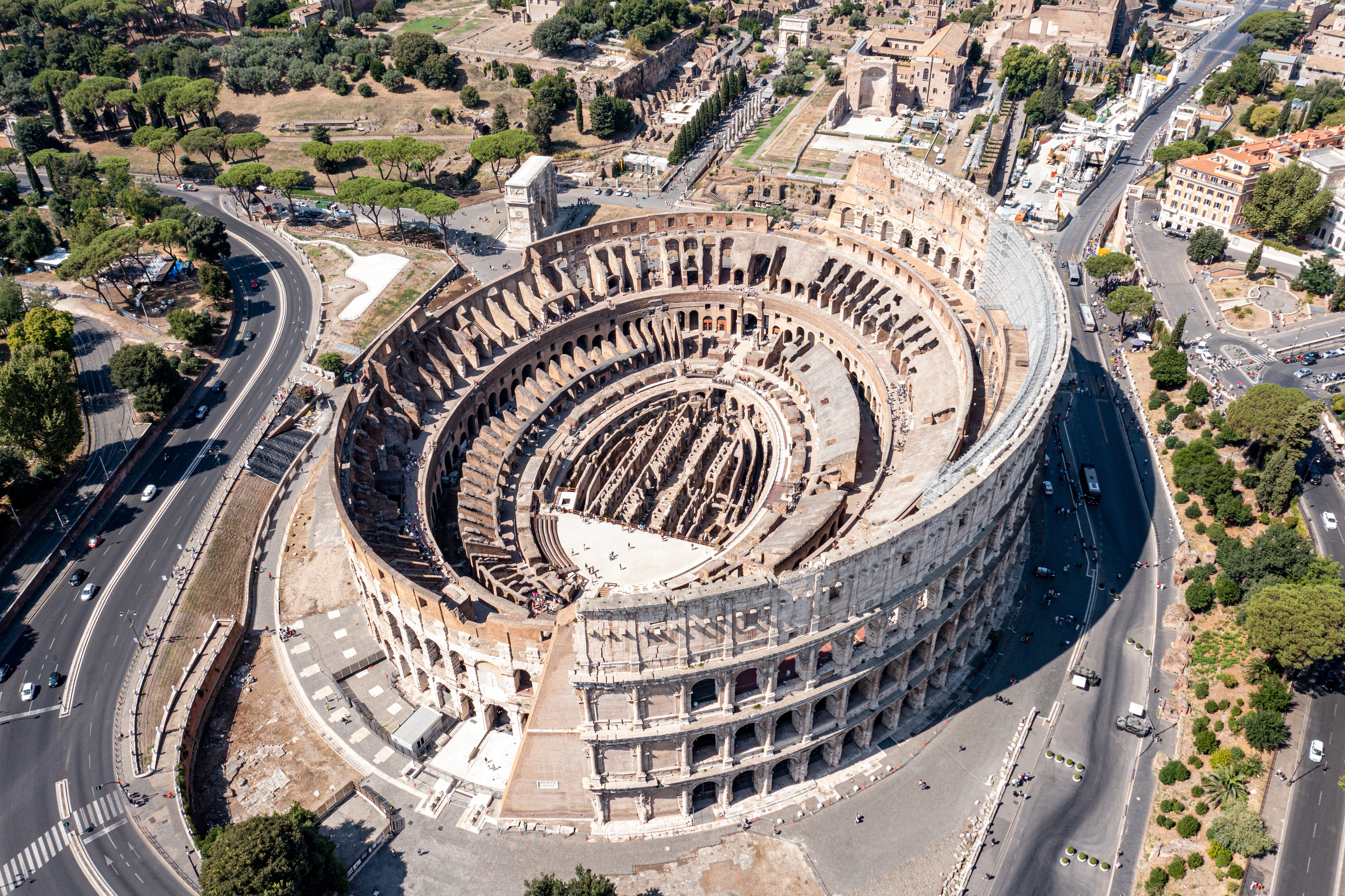
Rome is one of the empires that remain prominent in the imagination of the western world. While the victors write the history books, Rome seems to have garnered such a stature not just because they won (they didn’t), but because of key innovations in a variety of areas of life. Whether architecture (the arch and aqueducts), war (the phalanx), or government (the Roman senate), there is enough that captivates those interested in such areas to keep the Roman Empire interesting. The amount of destruction perpetuated by the Roman Empire is equally compelling. At its height, Rome had conquered much of modern day Western Europe (including Britain), Turkey and the Middle East, and Northern Africa. Over the course of the empire (approximately nine centuries) some estimates have tens of millions of people killed through war and war related activities (including the fall of the empire itself).
You can live well in empire.
This is the landscape into which Jesus comes, and says, “Follow me.”
This recent revelation helped me feel like I could expand my trust my in Jesus with specific regard to the moment of world history that I find myself in – one that feels somehow more and more unstable and out of my own control. If he had come to a council-based tribe, living in relative peace with all its neighbors, his life would have less for me to observe – to learn from.
Instead, I can look to the records and testimonies of Jesus’s life – the way he interacted with people from a variety of lineages, social statures, and life circumstances, and the stories he told and deeds he did to unmask reality in a world organized against it. I can look at the life he was able to lead – one of compassion, clarity, and love (to say little of anything else) – in the midst of Rome. I can ask, “How did he do that?” I can ask, “How can I do that?” I can engage in conversation, pursue answers, and ultimately work out my journey – finding answers to those very questions.
Most importantly I can follow this teacher trusting that what he will teach me is relevant in the particular time and place I find myself.
Wow, the bit about everyone having a pitch and that FOMO really resonated. It's so easy to get overwhelmed by all those voices promising answers. You articulated so well why discerning who to truely trust is absolutly crucial. Thanks for this insightful read!
This is an interesting and timely discussion. It is freeing to recognize the time in which Jesus chose to enter the world, grow, teach, heal, and share His Father's love. A surrendered will that acts in response to prompts from the Holy Spirit is likely more impactful than loud angry dissent.